

Lead handling in a franchise network covers everything that happens between the moment someone leaves an enquiry and the moment they walk into the site: receiving the enquiry, the first reply, qualification, booking the appointment, reminders, then following up with those who did not show up or have not decided yet. In a network, the problem rarely comes from a single stage. It comes from repeated leaks in every site that nobody sees at network level.
This guide is written for franchisors and head offices as well as franchisees and site managers. It describes the six stages of an enquiry, the leak specific to each one, how roles are split between head office and sites, the metrics to track and a self-assessment grid to fill in site by site.
What is lead handling in a franchise network?
A lead, here, is a person who has expressed interest: a form filled in on the network’s website, an enquiry from a Facebook or Instagram ad, a call, a message, a walk-in. Lead handling is the organisation that turns that enquiry into an attended appointment, then into a customer.
Franchising adds a twist: the enquiry is often generated by head office (national website, advertising, search), but it is handled locally by each site, with its own opening hours, team and habits. In between lies a grey area: who receives the enquiry, who calls back, how fast, and who knows what became of it?
That is why lead handling is as much a network management issue as a sales skill in each site.
The 6 stages of an enquiry and where leads leak
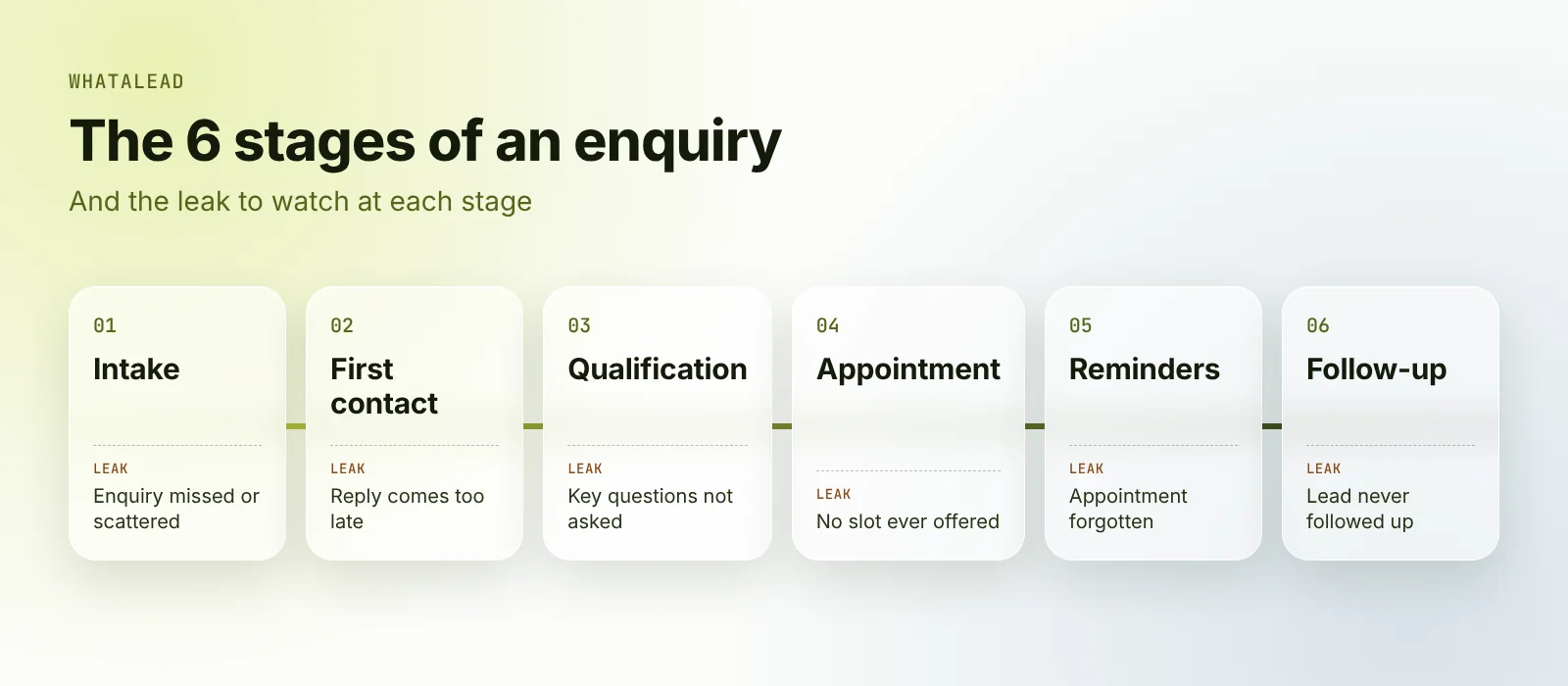
1. Intake: knowing an enquiry exists
An enquiry can come from the website form, an ad, a missed call, a social media message or a shared inbox. The first leak is fragmentation: each channel has its own queue, and some enquiries are never seen, or seen too late.
What to aim for: a single entry point per site, where every enquiry arrives with its source, time and contact details, whatever channel it came from.
2. First contact: replying before interest fades
Someone who fills in a form often contacts several sites or brands. They are likely to choose the one that replies first, and to give that one a warm welcome. A study published in Harvard Business Review on online enquiries reached this conclusion: most companies do not respond nearly fast enough (Oldroyd, McElheran and Elkington, “The Short Life of Online Sales Leads”, 2011).
Every site manager knows the leak: the evening or weekend enquiry, handled the next day between two customers, when the lead no longer picks up. The first contact must be able to go out within minutes, at any hour, on a channel the lead actually reads, and offer a concrete next step rather than an acknowledgement. For enquiries that arrive after closing time, see our WhatsApp Business auto reply templates and their equivalents on the website and the phone.
3. Qualification: asking the right questions
Qualifying means checking that the enquiry matches what the site offers and preparing the appointment: the person’s goal, availability, constraints, any criterion that points to one service rather than another. The leak is twofold: skip the questions and the first appointment is wasted; ask too many and the lead drops off.
A good practice is to set three to six common questions at network level, then let each site add what belongs to its local context. The questions to ask, how to phrase them and a script to copy are in our guide to lead qualification.
4. Booking: offering a slot, not a promise to call back
“We’ll call you back to book an appointment” is one of the sentences that loses the most leads. Every extra exchange before the appointment is another chance to stop hearing from each other. The leak is the slot that is never offered.
The goal is to offer real slots from the site’s calendar in the very first exchange, and to confirm the appointment in writing with the address, time and anything the person should bring.
5. Reminders: getting the person who said yes to show up
A booked appointment is not an attended one. Between booking and the visit, the person may forget, hesitate or be held up. The leak is the no-show, which blocks a slot and costs the team time.
A confirmation then reminder sequence (the day before, then on the day) also gives the person an easy way to reschedule, which is better than a no-show. The causes of no-shows and the full reminder sequence are covered in our guide to missed appointments in wellness centres, and the messages to send in our appointment reminder templates.
6. Follow-up: not giving up on those who have not decided
After the appointment, some people do not commit straight away. Others never came. Without organised follow-up, these contacts disappear into a file nobody reopens, even though each one has already cost an enquiry.
Follow-up covers three cases: following up after an appointment that did not convert, catching up with no-shows, and reactivating past leads months later, in line with consent rules (see below).
Franchise lead management: head office and site roles
Franchise lead management works when everyone knows what is theirs. A common split, to adapt to your network:
| Topic | Head office / franchisor | Site / franchisee |
|---|---|---|
| Generating enquiries | Website, national ads, search | Local awareness, word of mouth |
| Enquiry entry point | Common rules, routing to the right site | Reading and taking ownership |
| First contact and qualification | Common script, core questions | Local tone, site-specific questions |
| Appointments and reminders | Standard timings and messages | Calendar, welcome, execution |
| Follow-up and reactivation | Consent framework, network calendar | Personalised follow-ups |
| Measurement | Network dashboard | Reading its own figures |
The franchisor’s challenge is to make the lead experience consistent without taking away what makes each site’s local relationship. What should be shared: target timings, stages, the information collected and how it is measured. What can stay local: tone, slots, current offers.
Enquiries generated by head office (national website, ads, search) need particular care, because they change hands before reaching the site: see the 6 places national leads get lost between head office and sites, with a checklist for franchisors.
Tracking leads across a network: the metrics to watch
Tracking leads across a network relies on a few metrics measured the same way in every site. Without that, comparing two sites means comparing two counting methods.
- Number of enquiries received, by source and by site.
- Time to first contact: time between the enquiry and the first real reply (not the automatic acknowledgement).
- Contact rate: share of enquiries that led to an exchange.
- Booking rate: share of enquiries that led to a booked appointment.
- Show rate: share of appointments attended.
- Conversion rate: share of attended appointments that became customers.
- Pending follow-up volume: leads with no next action planned.
Read together, these figures show at which stage a site loses its leads. A site that books many appointments but sees few attended does not have the same problem as a site that is slow to reply. Formulas, review frequency and a dashboard template are in our guide to sales KPIs for a franchise network.
Self-assessment grid for each site
This grid is a teaching example designed by WhatALead for this guide. Answer for one site at a time, ideally with the person who handles enquiries day to day. Each “no” or “don’t know” points to a stage worth digging into.
| Stage | Question to ask | Yes / No / Don’t know |
|---|---|---|
| Intake | Do all enquiries, whatever the channel, arrive in the same place? | |
| Intake | Do we know the source of each enquiry? | |
| First contact | Does an enquiry received in the evening or at the weekend get a reply before the next day? | |
| First contact | Do we know our average time to first contact over the last two weeks? | |
| Qualification | Does the team ask every lead the same core questions? | |
| Booking | Is a slot offered in the first exchange? | |
| Booking | Is the appointment confirmed in writing? | |
| Reminders | Does every appointment get a reminder before the visit? | |
| Reminders | Can the lead easily reschedule rather than not show up? | |
| Follow-up | Does every unconverted lead have a dated next action? | |
| Follow-up | Do we know how many past leads could be contacted again, and with what consent? | |
| Measurement | Are these figures comparable from one site to another? |
The most revealing test is still to put yourself in a lead’s shoes: fill in your own network’s form on a weekday evening, then note who replies, how fast, on which channel and with what offer.
Converting leads in a site: contacting people by the rules
Improving lead conversion in a site must not come at the expense of contact rules. Two frameworks usually apply. The references below are French and Meta sources; check the rules that apply in your own country.
Marketing by email and text message (France). For individuals, the CNIL, France’s data protection authority, states that marketing through these channels requires their prior consent in principle, with an exception for existing customers when the marketing concerns similar products or services. Each message must also let the person easily refuse further messages (CNIL, in French).
WhatsApp. The WhatsApp Business Messaging Policy only allows you to contact someone who has given you their number and agreed to receive your messages; any request to stop must be respected (WhatsApp Business Messaging Policy). Meta’s documentation adds that the person must clearly know which business they are opting in to (Meta, “Get opt-in for WhatsApp”).
In practice: the enquiry form should collect explicit agreement to be contacted on the chosen channel, and that agreement should be stored with the lead’s record. This is also what makes reactivation possible later.
Where to start?
Start by measuring before changing anything. Three actions give you a first picture of your network:
- Test your journey as a real lead, in several sites, at different times of the week.
- Listen to the teams who handle enquiries: where do they lose time, which enquiries slip through?
- Find the stage where enquiries are lost, site by site, with the grid above and the shared metrics.
This is the approach WhatALead follows in its free audit. Then we build a tailored system, based on your methods: conversational journeys on the official WhatsApp Business API to reply within minutes, qualify and offer a slot, connected to your tools, with reminders and follow-ups on other channels, and results tracked per site. You can explore our 4-step approach or go back to the WhatALead overview.
Frequently asked questions
What is the difference between lead management and lead handling?
The two terms often mean the same thing. “Lead management” usually refers to the organisation (tools, routing, tracking) and “lead handling” to the work done with each person (reply, qualification, appointment). In a franchise, you need both.
Who should handle leads: head office or franchisees?
Most often, head office sets the framework (timings, script, metrics, consent) and each site handles its own enquiries. Some networks centralise the first contact to guarantee response times, then hand over to the site. The right choice depends on your enquiry volume and how autonomous your franchisees are.
How quickly should you reply to a lead?
As soon as possible, ideally within minutes. What matters is measuring your actual response time, site by site, including evenings and weekends, before setting a common target for the network. Our method for measuring prospect response time at every site gives the logging grid and a standard per channel.
Do you need a CRM to handle leads well?
A CRM helps centralise and measure, but it does not reply in place of the team. The starting point is a clear journey and shared metrics; the software then serves them. More guides on this topic are coming to the WhatALead blog.