

Your sites assure you they call enquiries back “the same day”, but nobody at head office really knows how long it takes? And a prospect who writes on Saturday evening may be waiting until Monday?
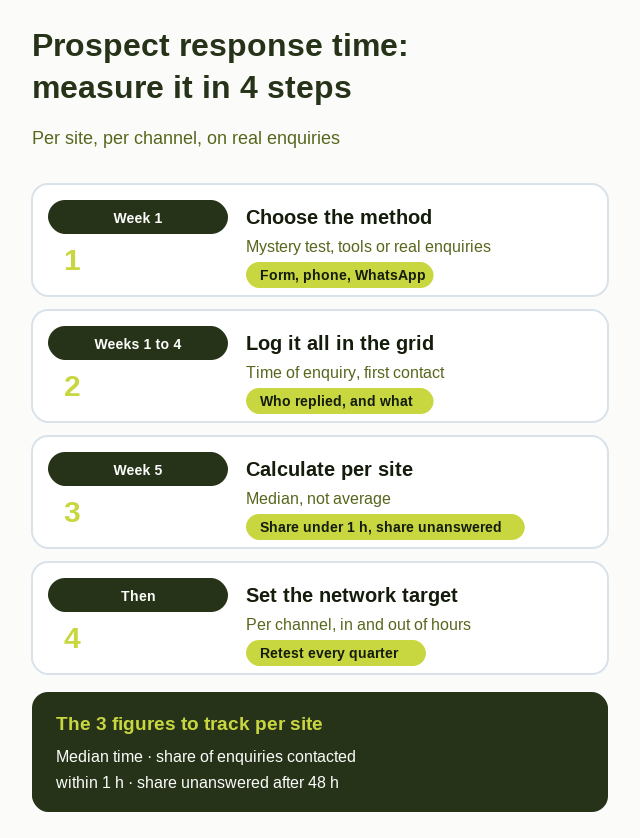
Prospect response time does not improve until it is measured, and it has to be measured site by site, channel by channel, on real enquiries. In practice: four weeks of logging in a shared grid, three figures per site, then a response-time target set by the network for each channel.
This article is for franchisors and network managers in any sector (wellness, fitness, beauty, services). It covers three measurement methods, a logging grid to copy, a worked example, a response-time standard to adapt and a seven-question self-test.
Key takeaways
- First contact is the stage where enquiries go cold fastest: it is stage 2 of our guide to lead handling in a franchise network.
- Measure the time to the first useful human contact, not to the acknowledgement. A well-written auto reply buys time, but it does not count as a reply.
- Three figures per site are enough: the median time, the share of enquiries contacted within an hour and the share still unanswered after 48 hours. See the logging grid.
- A slow site always has a specific cause (nobody notified, front desk overloaded, enquiry judged poor quality): find it among the six leak points of national leads.
Would you rather have an outside view take the measurement? Request WhatALead’s free audit: we test your sites as real prospects, on every channel, and give you response times site by site.
Why prospect response time is the metric that matters
Response time is the first metric to track because it drives all the others: an enquiry called back too late becomes neither an appointment nor a client, however good the welcome is afterwards. The person has often contacted several sites, and their interest fades within hours.
Recent studies show that companies reply far more slowly than they think.
- 114 B2B companies tested by Workato (March 2026). After a demo request, more than 99% of companies did not reply within 5 minutes. The first personalised email arrived after 11 hours 54 minutes on average, and only 31% called back, after 14 hours 29 minutes on average (Workato, “B2B Lead Response Times: What We Learned from 114 Companies”, March 2026).
- 1,333 US law firms tested by Hennessey Digital (2025). Using a form filled in under a fictitious alias, 26% did not reply at all within seven days, 56% replied within the hour and the median time was 13 minutes (Hennessey Digital, “2025 Lead Form Response Time Study”).
- 6,346 contact forms filled in by Clay (September 2026). The experiment, run with a fictitious identity and every reply timestamped, sums up its result in its title: most companies never replied (Clay, “On a demandé une démo à 6 346 entreprises”, September 2026, in French).
None of these studies covers franchise networks, and two are published by software vendors. They still show the same thing: without measurement, the gap between assumed and real response time stays invisible. And their method, a real enquiry sent and then timed, is exactly what a head office can apply to its sites.
3 ways to measure response time at a site
Each method measures something different, so the most reliable approach is to combine them: the mystery test shows what a prospect experiences, the tools give the volume, and a sample of real enquiries checks both.
1. The mystery test: form, phone, WhatsApp
Head office (or a third party) acts as a prospect and contacts each site through each of its channels: national website form, phone call to the site, WhatsApp message, enquiry from an ad. For each test, note the exact time it was sent, then the time of the first human contact.
- Vary the timing: a weekday morning, a lunch break, an evening after closing, a Saturday. Out-of-hours enquiries are the ones that wait longest.
- Plan at least three tests per site and per channel over four weeks, so you do not judge a site on one busy day.
- Keep the enquiry credible and consistent (same need, same level of detail) so sites can be compared.
- Do not record calls. Note the times and what was said by hand. In France, listening to or recording calls at work requires prior information of employees and the people they speak to, and consultation of staff representatives (CNIL, “L’écoute et l’enregistrement des appels sur le lieu de travail”, a 2009 page flagged as being updated). Check the rules that apply in your country.
2. Your tools’ timestamps
Your booking software, CRM, the inbox that receives forms and WhatsApp Business all keep the time of each message. For each enquiry, the gap between arrival and first reply gives the response time, across the whole month’s volume.
The limit is channels that leave no trace: a missed call returned from the manager’s mobile, a message read and then handled in person. Tools therefore measure written channels well and the phone poorly.
3. A sample of real enquiries
Take the last twenty enquiries head office passed to a site, and ask the site for the time of its first contact for each. Compare with the time they were sent. This method checks what the tools say and reveals enquiries that were never called back.
Work from an extract limited to times and channels, without copying people’s contact details into yet another file: you only need the timestamps.
The logging grid to copy
The grid is shared across the network, because that is the only way to compare sites under the same rules. One row per enquiry, test or real.
| Site | Channel | Day and time of enquiry | First human contact | Time | Who replied | What the reply said |
|---|---|---|---|---|---|---|
| Example: Leeds | Form | Sat. 6:40 pm | Mon. 10:15 am | 39 h 35 | Front desk | Call back, slot offered |
| Phone | ||||||
Three rules make the grid reliable:
- The clock runs until the first human contact, not until the automatic acknowledgement. An evening auto reply is useful, but it does not replace the call back.
- An enquiry with no contact after 48 hours is logged as “unanswered”, not ignored: it is often the most telling figure.
- The “what the reply said” column matters as much as the time. A fast call back that offers neither a slot nor a qualifying question does not move the enquiry forward. Our six questions to qualify a prospect give a shared baseline.
After four weeks, calculate three figures for each site: the median time (rather than the average, which a single forgotten enquiry distorts), the share of enquiries contacted within one hour and the share unanswered after 48 hours.
Want this grid filled in without spending your weeks on it? During WhatALead’s free audit, we test your sites as real prospects and give you the completed grid, site by site.
Illustrative example: what a slow response costs
This is a fictitious calculation to illustrate the method. Replace each assumption with your own figures.
| Assumption (illustrative example) | Value |
|---|---|
| Enquiries received per month at one site | 100 |
| Share contacted after more than 24 hours | 30%, i.e. 30 enquiries |
| Appointments from these 30 late call backs | 1 in 5, i.e. 6 |
| Appointments they would have given if called within the hour | 2 in 5, i.e. 12 |
| Share of appointments that become clients | 1 in 3 |
| Revenue from a new client | €600 |
| Revenue lost | (12 − 6) ÷ 3 × €600 = €1,200 per month per site |
Across a network of ten sites, the same calculation gives €12,000 per month, or €144,000 per year. The grid gives you the second row with your real figures; it is often the one that surprises.
Setting a response-time target for the network
A shared target only makes sense if it accounts for channel and timing, because you do not promise the same time to a Tuesday-morning call and a Sunday-evening form. Here is a starting standard, to adapt to your opening hours and organisation:
| Channel and timing | Immediate response | First human contact |
|---|---|---|
| Call during opening hours | Answered, or SMS if the call is missed | Call back within the hour |
| Form or WhatsApp during opening hours | Acknowledgement with a precise time | Within the hour |
| Any enquiry in the evening or at weekends | Auto reply with call-back time and booking link | Before 10 am on the next opening day |
Write this standard into the network charter, then measure it every quarter with the same grid. A target without regular measurement becomes an intention again. Target times are part of what head office sets and each site executes, as our guide to lead handling in a franchise network explains.
What to do about slow sites
A slow site is almost never a site that does not care: response time reveals an organisational problem, so the first step is to find which one before asking anyone to go faster.
- Nobody is notified in time: the enquiry lands in an inbox nobody checks during treatments. It is the second leak point of national leads.
- The front desk is overloaded at peak times: the call back waits until the end of the day.
- The enquiry is judged poor quality and left aside, without telling head office.
- The first call fails and nobody follows up in writing.
Share results with each site using its own row, compared with the network median, rather than a public ranking. Then retest the following month: it is the only way to know whether the fix worked. Response time is only the first of the seven sales KPIs to track at each site: tracking them together shows whether the site also loses enquiries further down the line.
Test your network in 7 questions
Answer “yes” or “no” thinking about the last four weeks.
- Do you know the median first-contact time of each of your sites?
- Is this time measured separately for the form, the phone and WhatsApp?
- Have you tested your sites in the evening or at weekends in the last quarter?
- Do you know what share of enquiries is still unanswered after 48 hours?
- Does the network have a written response-time target that every site knows?
- Do all sites use the same rule to log the time of first contact?
- Does each site receive its own results at least once a quarter?
Reading your result (count the “no” answers):
- 0 to 1: your network already manages its response time. Keep the quarterly rhythm and watch the unanswered share.
- 2 to 3: you have an idea of the response time, but no comparable measurement across sites. Start with the grid, over four weeks.
- 4 or more: your sites’ real response time is unknown to you. Run the worked example with your own volumes to estimate what it may cost.
WhatALead can run this diagnosis with you: book your free audit. We send real enquiries to your sites, on every channel and at any time, and give you each site’s response times and leaks. No commitment.
Frequently asked questions
What response time should you aim for with a prospect?
As short as possible during opening hours, ideally under an hour to the first human contact. Out of hours, an immediate auto reply that gives the call-back time, then a call back as soon as you open. Then set your own target from the times measured at your sites.
How do you measure response time without a tool?
With a mystery test and a shared grid: send enquiries to each site on each channel, note the time sent and the time of the first human contact, over four weeks. A spreadsheet is enough to calculate the median time and the share of unanswered enquiries.
Should sites be told about a test?
Tell them about the principle, not the dates. Stating in the network charter that test enquiries will be sent regularly avoids any sense of a trap and keeps the measurement true to what a real prospect experiences. Do not record test calls.
Who should reply to prospects: head office or the site?
Usually the site, which knows its calendar and clients, within a time set by head office. Some networks centralise first contact to hold the target, then pass the enquiry to the site. Measuring site by site tells you which of the two models suits you.
Measured response times, then enquiries that become appointments
A network that knows each site’s real response time knows where to act: the inbox nobody reads, the overloaded front desk, the evenings with no reply. WhatALead starts with an audit: we test your sites as real prospects and measure where enquiries go cold. Then we build a tailored system, based on your methods, so every enquiry gets a reply within minutes, on WhatsApp, by SMS, RCS, email or phone.
Book your free audit and find out how fast your sites really reply.