

Missed appointments cost a wellness centre far more than an empty slot: team time, a lead already paid for in advertising, sometimes a customer who will never come back. The good news is that a no-show almost always has an identifiable cause: forgetting, an appointment booked too far ahead, hesitation, being held up with no easy way to let you know, or a poorly prepared appointment. Each cause has its answer, and most fit into a well-built sequence of messages between booking and the visit.
This guide is for managers of weight-loss, beauty, fitness or nutrition centres, and for franchisors who want consistent practices across their network. It covers the five causes of a missed appointment, a method to calculate what they cost, the sequence that handles them and what to do when a client does not show up.
Missed appointments: what are we talking about in a wellness centre?
A missed appointment, or no-show, is a booked appointment the person does not attend, without letting you know. It is one of the six stages of lead handling in a franchise network, the one played out between booking and the visit. It differs from two related situations:
- Late cancellation: the person lets you know, but too late for the slot to be offered to someone else.
- Rescheduling: the person moves the appointment. That is a far better outcome than a no-show, and a good system should make it easy.
In a wellness centre, the issue weighs most on the first appointment: assessment, trial session, skin diagnosis, first nutrition consultation. It is the moment when the person does not know the centre yet, commitment is lowest and hesitation highest. Follow-up appointments with committed clients are generally better attended.
The 5 causes of a missed appointment
1. Forgetting
The most common cause and the easiest to handle. The appointment was booked by phone or form, no written confirmation arrived, and the date faded between two busy days. With nothing in writing, the person cannot even find the address or time.
2. An appointment booked too far ahead
The longer the gap between booking and the visit, the more the initial motivation fades. Someone who asks for an assessment on a Monday evening, motivated, is not in the same frame of mind twelve days later. The first lever is to offer near slots where possible; the second is to keep in touch between the two dates.
3. Hesitation
A first appointment in a wellness centre involves more than it seems: talking about one’s weight, skin, fitness, sometimes a budget. Some no-shows are silent withdrawals: the person fears being judged, being pushed into a sale, or does not know what to expect. Reassuring them before the appointment (how it works, how long it lasts, what to bring, no commitment) addresses this cause directly.
4. Being held up with no easy way to let you know
A sick child, a meeting that overruns, a late train. The person would have warned you if it were easy, but they have to call the centre during opening hours, get the voicemail, call again… and end up doing nothing. Every time rescheduling takes effort, some of those situations turn into no-shows.
5. A poorly qualified appointment
Some appointments should never have been booked as they were: the person had another service in mind, lives too far away, or only wanted a price. Without a few questions at first contact, the centre blocks a slot for someone who will not come. This is handled upstream, when the enquiry is processed, with a few qualification questions asked before the slot is booked.
What a no-show costs your centre
The cost of a missed appointment is not limited to the revenue of the session. To estimate it, add up four items:
- The lost slot: what that slot would have brought in had it been filled.
- Team time: preparation, waiting, attempts to call back.
- The cost of acquiring the lead: what the enquiry cost (advertising, search, share of network marketing).
- The value of the lost client: for a first appointment, the person who does not come will probably never become a client if nobody contacts them again.
Fictional example, to illustrate the method: a centre books 60 first appointments a month and sees 9 missed. If a client who starts a programme is worth €600 on average and one attended first appointment in three leads to a programme, each no-show represents about €200 of potential revenue, or €1,800 a month for that centre, before counting team time and the cost of enquiries. Replace these values with yours: the calculation is the same for every centre.
At network level, multiply by the number of centres: this is often the calculation that turns the topic from a day-to-day annoyance into a management priority.
Reducing no-shows: the sequence that handles each cause
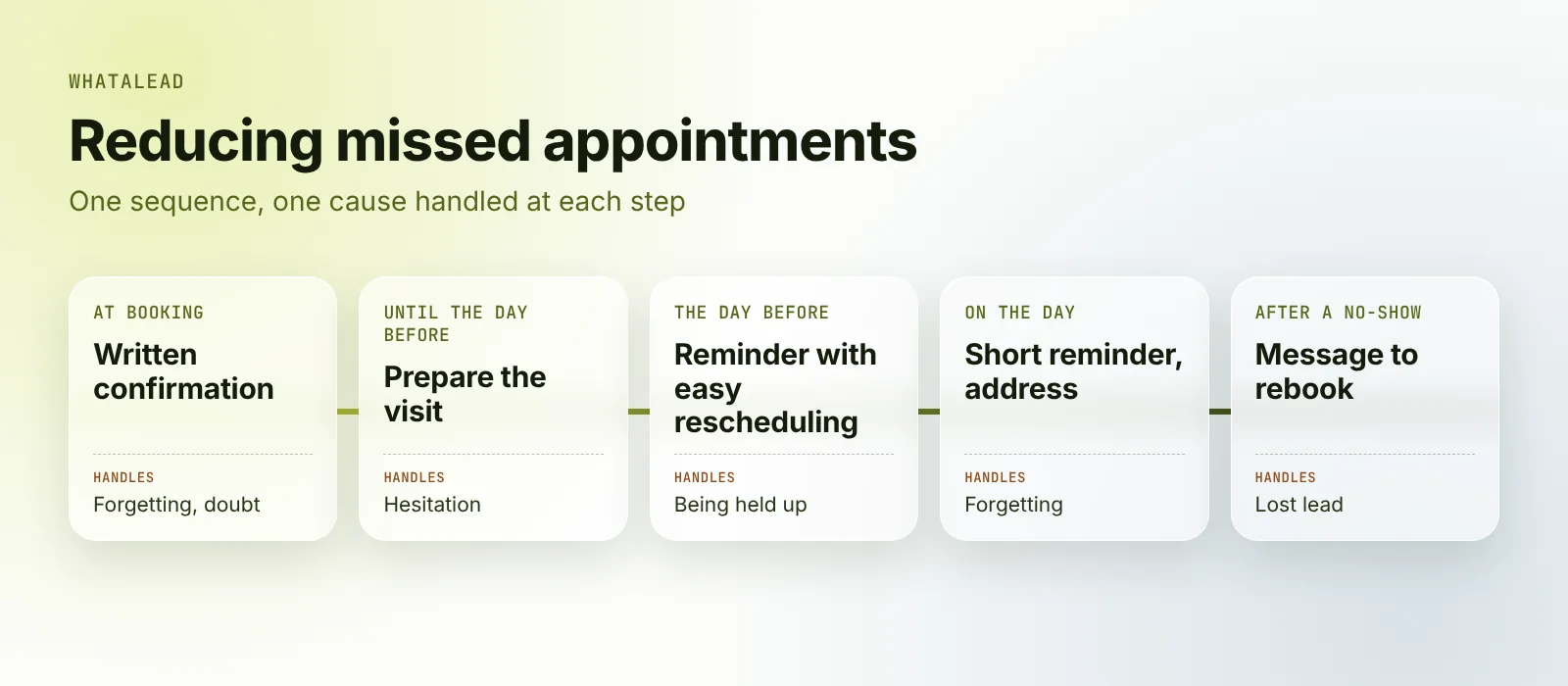
Reducing no-shows does not mean sending more and more reminders. It means placing the right message at the right moment, each one handling a specific cause.
| Moment | Message | Cause handled |
|---|---|---|
| At booking | Written confirmation: date, time, address, duration, contact person | Forgetting, doubt |
| Between booking and the day before | Preparation: how it works, what to bring, answers to common questions | Hesitation, long gap |
| The day before | Reminder with a one-tap option to confirm or reschedule | Being held up |
| On the day | Short reminder a few hours before, with address and access | Forgetting |
| After a no-show | Kind message offering to rebook | Lost lead |
For each moment, you will find ready-to-copy SMS and WhatsApp appointment reminder templates. Three principles make this sequence work:
- Write on the channel the person actually reads. For many clients, that is WhatsApp rather than email.
- Let them reply. A reminder they can answer with “I can’t make it, do you have Thursday?” turns a no-show into a rescheduled visit.
- Keep the centre’s tone. A cold, administrative reminder reassures less than a message that sounds like the welcome they will get on site.
When a client does not show up: what next?
When a client does not show up, the worst reaction is no reaction. A message within a few hours, without blame, wins back some of the absentees: “We didn’t see you today, I hope everything is fine. Would you like us to offer you another slot?”
You will find six missed appointment message templates, in SMS, WhatsApp and email, by situation. Then handle each case:
- First missed appointment: offer a new slot soon, and check that the service really matches the request.
- Repeated no-shows: it is fair to ask for explicit confirmation the day before blocking a slot, or even to consider a deposit (see below).
- No reply: schedule a later follow-up, then keep the person in your past-leads base, to be reactivated later in line with their consent.
At network level: measuring the show rate
For a franchisor, no-shows are a management metric in their own right. The show rate (attended appointments divided by booked appointments) should be measured the same way in every centre, separating:
- first appointments and follow-up appointments;
- no-shows, late cancellations and rescheduled visits;
- the source of the enquiry (website form, ad, call, walk-in).
Comparing centres then shows which ones have found a good practice, so it can be rolled out across the network: confirmation template, maximum delay between enquiry and appointment, message after a no-show.
Deposits and card guarantees: when to consider them?
Asking for a deposit or a card guarantee at booking discourages no-shows, but it also adds friction just when the lead is already hesitating. It is therefore rarely the first lever for a first discovery appointment. It can make sense for long or expensive services, or for people who have already missed several appointments.
If you are considering it, have the applicable conditions checked (client information, cancellation terms, the legal nature of the payment in your country) before adding it to your terms and conditions.
Appointment reminders and consent
A reminder about an appointment the person booked is not the same as a marketing message, but contact rules still apply, especially when you write again to follow up or reactivate. The references below are French and Meta sources; check the rules in your own country.
- Email and text message (France): for individuals, the CNIL, France’s data protection authority, states that marketing through these channels requires prior consent in principle, with an exception for existing customers and similar products or services, and that each message must let the person refuse further messages (CNIL, in French).
- WhatsApp: the WhatsApp Business policy only allows you to contact someone who has given you their number and agreed to receive your messages, and requires you to respect any request to stop (WhatsApp Business Messaging Policy). Meta adds that the person must clearly know which business they are opting in to (Meta, “Get opt-in for WhatsApp”).
In practice, collect the person’s agreement to be contacted on the chosen channel when they book, and store it with their record.
Where to start?
First, measure your show rate over the last four weeks, separating first appointments and follow-ups. Then reread the messages a client actually receives between booking and the visit: often there is only one, or none.
This is the kind of finding WhatALead makes during its free audit: we test your journey as a real lead, listen to your team and find where appointments are lost. Then we build a tailored system, based on your methods: confirmation, reminders and rescheduling handled in conversational journeys on the official WhatsApp Business API, relayed by RCS, SMS or email when useful, connected to your calendar, with the show rate tracked per site. Explore our 4-step approach or the WhatALead overview.
Frequently asked questions
When is the right time to send an appointment reminder?
The most common sequence combines an immediate confirmation, a reminder the day before and a short reminder on the day. The day-before reminder is the most useful for catching people who are held up, provided it makes rescheduling easy.
Should you charge for a missed appointment?
It is possible if your terms provide for it and the client was informed before booking, but it can put people off first appointments. Have the applicable rules checked and keep this measure for repeated cases or long services.
Why are first appointments missed more often?
Because the person does not know the centre yet, commitment is low and hesitation is high. A reassuring confirmation and a well-prepared appointment address these barriers directly.
Are automated reminders enough?
They handle forgetting, but not hesitation or a poorly qualified appointment. The best results come from a sequence that lets the client reply, and a team that takes over when a conversation calls for it. More guides on this topic are coming to the WhatALead blog.