

Your head office pays for the national website, advertising and search, yet your sites say they receive far fewer enquiries than your dashboard shows? And when you ask what happened to last month's enquiries, nobody can really answer?
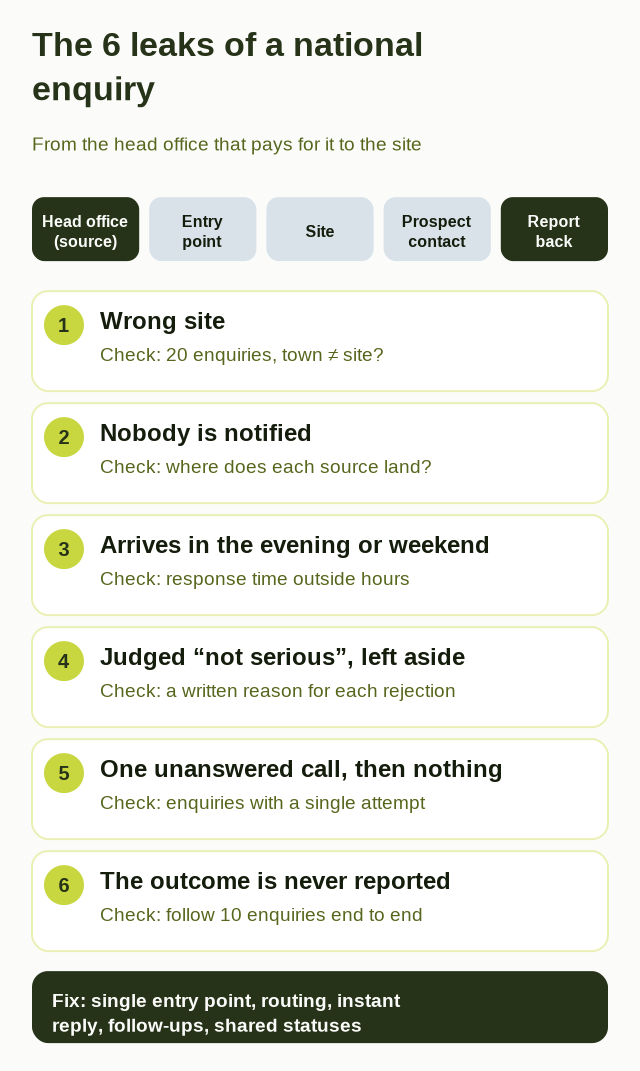
This is not a problem of a site that "doesn't work hard enough". National leads get lost in the handovers between head office, which pays for the enquiry, and the site, which has to handle it: an enquiry can disappear in six specific places, and each one can be spotted with a check you can run yourself this week.
This article is for heads of multi-site networks, whatever the sector. You will find the six leak points, a calculation of what they cost, a ten-question test to assess your own network, and how to split roles between head office and sites.
Key takeaways
- A national enquiry changes hands at least four times before the first conversation with the prospect. Every handover is a possible leak: this is the journey described in our guide to lead handling in a franchise network.
- Speed matters: in the Harvard Business Review study of 2,241 US companies, 23% never responded to an online enquiry. See the figures and what they cost.
- An enquiry judged "not serious" is often a poorly qualified one: a shared set of questions settles the debate between head office and sites.
- One contact attempt is not enough: plan a follow-up sequence, as you would after a missed appointment.
- You can measure your leaks in one week with the 10-question test in this article.
Want to know where your network's enquiries get lost without spending a week on it? Ask for the free WhatALead audit: we test your journey as a real prospect, across several sites.
What lost enquiries cost
A lost enquiry costs twice: head office has already paid to get it, and the site loses the client it could have become. And time works against you, because a prospect's interest fades fast.
An audit of 2,241 US companies published in Harvard Business Review in 2011 measured it: 37% responded to an online enquiry within an hour, 24% took more than 24 hours, and 23% never responded (Oldroyd, McElheran and Elkington, "The Short Life of Online Sales Leads", HBR, March 2011, figures reported by SmartCompany, July 2011). In a second part of the study, covering 1.25 million leads, companies that contacted the prospect within an hour were nearly seven times as likely to qualify the lead as those that waited an hour longer.
In France, the Open-to-dialog barometer reported by Le Monde Informatique found only 27% of responses within an hour at the end of 2015, and 22% of companies unreachable on the number they displayed (Le Monde Informatique, 15 March 2016, in French). These studies are old and do not cover franchise networks, but they show an order of magnitude: a large share of enquiries never gets a quick answer.
For a network, the calculation takes four figures. Here is an illustrative example, with assumptions to replace with your own:
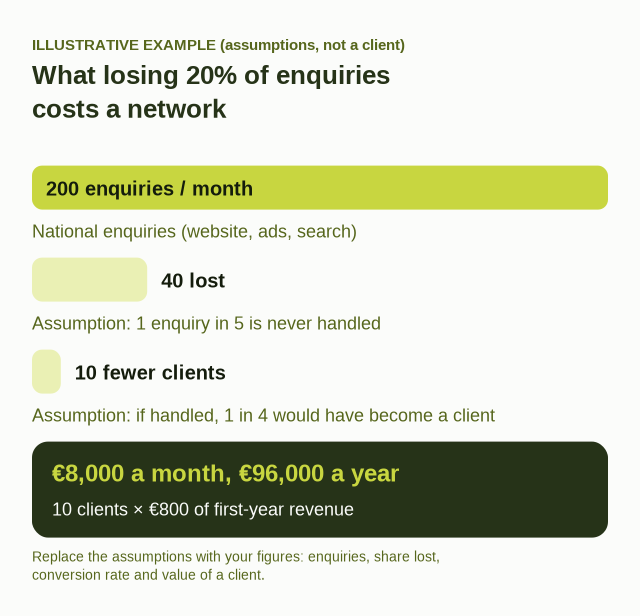
| Assumption (illustrative example) | Value |
|---|---|
| National enquiries per month | 200 |
| Share never handled | 1 in 5, i.e. 40 enquiries |
| Share that becomes a client when handled | 1 in 4, i.e. 10 clients |
| First-year revenue per client | €800 |
| Lost revenue | €8,000 a month, €96,000 a year |
Run the same calculation with your figures, then compare the result with the advertising budget that generated those enquiries: that is what the network pays for without benefiting from it.
The 6 leak points of national leads
1. The enquiry does not reach the right site
When the form does not ask for the town, or the routing rule is not written down, the enquiry goes to the default site or to whoever "covers the region". The site that receives it is too far away to convert it, and the one that could have done so never saw it.
- Symptom: one site receives enquiries from prospects living at the other end of the region, another receives almost none.
- Check: take twenty recent enquiries and compare the town or postcode given with the site that received them.
- Fix: a written routing rule (postcode, radius, site chosen by the prospect), a mandatory field in every form, and a rule for areas covered by two sites.
2. It arrives, but nobody is notified
Each source often has its own landing point: the website inbox, the ad platform interface, a shared sheet. If nobody is named to check it, the enquiry waits, and every hour of waiting lowers your chances of converting it.
- Symptom: the site discovers enquiries several days old in a generic inbox or inside a platform interface.
- Check: verify where each source lands. Ad platform forms keep enquiries on their side until someone retrieves them: Google Ads stores leads from its forms for 60 days, and CSV download only covers the last 30 (Google Ads, "About lead form assets").
- Fix: a single entry point for every source, with an immediate notification to a named person. In its best practices, Google describes two ways to connect its forms to your lead tracking software: a webhook or its API (Google Ads, "Best practices to integrate lead form ads with your CRM").
3. It arrives outside opening hours
Prospects fill in a form when they have time, so often in the evening or at the weekend, when the site is closed. As a result, the enquiry is handled on Monday, after the day's own enquiries, while the prospect had the whole weekend to contact a competitor.
- Symptom: evening and weekend enquiries are handled on Monday, if at all.
- Check: sort one month of enquiries by arrival time, then look at the first-contact time for those that arrived after closing.
- Fix: an immediate reply that acknowledges the enquiry and already offers something (a slot, a question), on the channel the enquiry came from or the one the prospect reads most: SMS, WhatsApp, email. The team picks up the conversation when the site opens instead of starting it. Our evening and weekend away message templates give you ready-to-adapt texts.
4. The site judges it poor quality and leaves it
The site has limited time, so it prioritises the enquiries it considers safest, often the ones it generated itself. If national enquiries seem less serious, because they arrive with little information or from a prospect who filled in several forms, they go to the bottom of the pile, then drop off it.
- Symptom: the site feels that "national leads are no good" and prioritises its local enquiries.
- Check: ask the site to sort the month's national enquiries (serious, to follow up, off-topic) with a reason. Without a written reason, the judgement stays an impression.
- Fix: a shared set of questions to qualify every enquiry the same way. Our article on lead qualification questions offers six questions and the next step for each answer.
5. First contact fails with no follow-up
Many prospects do not pick up when an unknown number calls. If the only planned action is a call, the enquiry stops at the first "no answer", when the prospect might well have replied to a written message within the hour.
- Symptom: the record says "called, no answer", and nothing else.
- Check: across last month's enquiries, count those with only one contact attempt.
- Fix: a written sequence (call, written message, second attempt at another time of day) and a rule for when to stop. The same logic applies after a missed appointment: our article on missed appointments in wellness centres covers reminders and follow-ups.
6. The outcome never reaches head office
Head office sees what it pays for (enquiries, advertising cost), but not what enquiries become, because each site records follow-up its own way, or not at all. Without that feedback, there is no way to know which source brings clients, or which site needs help.
- Symptom: head office knows the number of enquiries and the cost of advertising, but not how many became appointments or clients.
- Check: for one source, try to follow ten enquiries to their outcome. If you cannot, that is where the leak is.
- Fix: a few shared statuses (contacted, appointment booked, attended, client, lost with the reason) updated by the site, and a monthly review per site.
Test your network in 10 questions
Answer "yes", "no" or "I don't know". Each question matches one of the six leaks.
- Does each source of national enquiries land in a single place everyone knows? (leak 2)
- Do all your forms ask for the town or postcode? (leak 1)
- Across twenty recent enquiries, did each one reach the site closest to the prospect? (leak 1)
- Is a named person notified as soon as an enquiry arrives, at every site? (leak 2)
- Does an enquiry sent on a weekday evening get a reply before noon the next day? (leak 3)
- Do you know each site's real first-contact time? (leak 3)
- Do sites record a written reason when they set an enquiry aside? (leak 4)
- Does every enquiry get at least two contact attempts, on two channels? (leak 5)
- Can you follow ten enquiries from source to appointment or reason for loss? (leak 6)
- Do statuses reach head office in the same format for every site? (leak 6)
Reading your score (count the "no" and "I don't know" answers):
- 0 to 2: your process is under control. Still check question 5 with a real test enquiry: it is the one most often overestimated.
- 3 to 5: enquiries are leaking at one or two stages. Start with the leak that comes up most in your answers.
- 6 or more: part of the enquiries paid for by head office never reaches a conversation. Rerun the calculation above with your figures: that is your lost revenue.
The "I don't know" answers count as much as the "no" answers: they show what the network does not yet measure.
We can run this test with you, in the field: book the free WhatALead audit. We send real enquiries to several of your sites, listen to your teams and give you the list of leaks, site by site. No commitment.
Who does what between head office and sites
Leaks often come from a grey area, because everyone thinks the other side is handling it. In a franchise, that grey area is built in: the French Franchise Federation describes the franchisee as an independent entrepreneur, to whom the franchisor owes technical and commercial assistance, without running the site in their place (Fédération française de la franchise, "La franchise c'est quoi ?", in French). The answer is therefore shared rules, not centralising everything.
- Head office sets the shared rules: routing, target first-contact time, qualification script, statuses to report, consent framework. It provides the single entry point and reads the figures per site.
- The site takes ownership of every enquiry received, makes contact, qualifies, offers a slot and updates the status.
This split also has a legal side. In France, the data protection authority (CNIL) explains that when two or more parties jointly decide why and how personal data is processed, they are joint controllers and must set out together, in writing and transparently, how they share their GDPR obligations (Article 26) (CNIL, "Responsable du traitement, sous-traitants : comment bien identifier son rôle ?", in French, 6 June 2025). Have your legal adviser confirm how this applies to your network.
For a stage-by-stage split, see the section on head office and site roles in our guide.
Frequently asked questions
Should calls and enquiries be centralised at head office?
Centralising the entry point helps you lose nothing and measure everything. Centralising the handling is a different decision: the site knows its slots, services and access. A common approach is to receive every enquiry in one place, reply immediately, then pass it to the right site with the first details.
Who pays for national leads?
It depends on the franchise agreement and the rules of the network's marketing fund. Whatever the split, the site receiving enquiries should know where they come from, so that cost and outcome can be matched.
How do you know whether a site follows up its enquiries?
By measuring first-contact time and the number of attempts from updated statuses, and by sending a test enquiry from time to time. A "contacted" status with no date or channel is not enough. See our grid for measuring each site’s response time.
What should you do about a site that does not handle its enquiries?
Start with the facts: how many enquiries received, how many contacted, how quickly. Then look for the cause with the site (lack of time, badly routed enquiries, enquiries judged poor) before deciding. If the team lacks time, an automatic first message and online booking take load off the site without taking the relationship away. If the prospect does not show up, our message templates after a missed appointment help with the follow-up.
Recovering your network's lost enquiries
The six leaks are fixed with shared rules and a single entry point. WhatALead starts with an audit: we test your journey as a real prospect, listen to your teams and find where enquiries get lost. Then we build a tailored system based on your methods: every source received in one place, a reply within minutes through conversational journeys (official WhatsApp Business API, SMS, RCS or email depending on your prospects), routing to the right site, hand-over to your teams, integration with your tools and performance tracking per location. To get started, book your free audit.