
01 · Context
Two centres with different constraints.
The work concerns two franchisees of the JFG Clinic brand. Their shared goal is to turn more requests into appointments and to prepare clients’ visits. Their operational priorities are not the same, though.
The first centre has older contacts who had already filled in a form. The second mainly wants faster, easier first replies. The work was therefore built at the level of the centres supported, with journeys adapted to each one.
02 · The obstacle
Re-engaging a database and smoothing the welcome do not need the same message.
For the first centre, an old request does not tell you whether the project is still current. Interest has to be revived, the person’s situation understood and, if the need is confirmed, they must be guided towards an appointment.
For the second, the friction comes earlier: getting a reply and clarifying the essentials without making the conversation heavy. On top of that comes the follow-up between booking and visit, so the client can confirm or flag a change.
03 · The choice
Fit the journey to each franchisee’s real work.
The answer combines reactivation, qualification and follow-up until the appointment. For older contacts, a specific offer and outreach reopen the conversation. Recent requests go through qualification of the need, location and interest.
In the second centre, reply buttons and deliberately short qualification reduce the effort asked of the lead. First interactions are automated, then the team keeps control of the relationship and next steps.
04 · Implementation
Two entry points, a clear handover to the teams.
The first journey separates older contacts from recent requests. The second favours a simple reply to first enquiries. Useful information prepares the team’s takeover instead of just passing on a phone number.
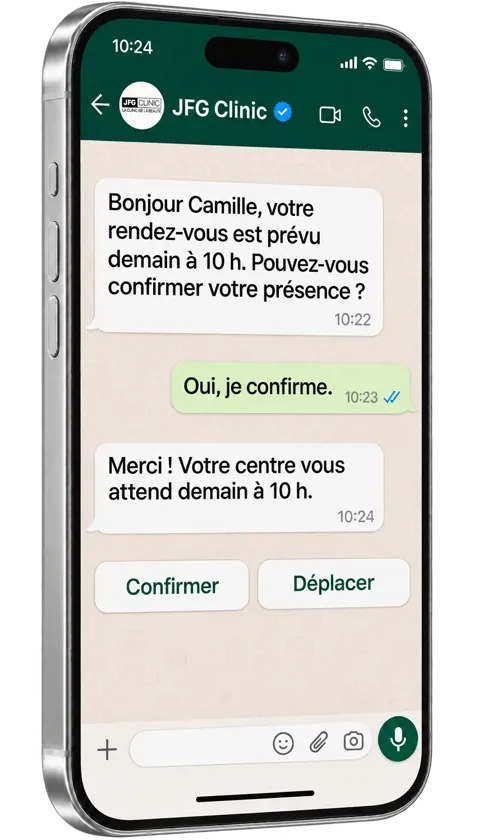
Follow-up continues with WhatsApp reminders and confirmations. Clients can confirm or ask to reschedule in the conversation. This requires deciding who handles a reschedule request and how the calendar is kept up to date.
- 01Older contact or recent request
- 02Reactivation or short qualification
- 03Appointment with the centre
- 04Confirmation or reschedule request

05 · Results
Time savings documented at the level of one centre.
The first franchisee’s review reports about one hour saved per day on average and all leads in scope being handled. The second centre’s review reports 89% of leads contacted.
These figures concern two distinct journeys. They do not measure the effect of reminders alone and do not, on their own, give a no-show reduction rate. The operational change is broader: picking requests back up, qualifying them and preparing next steps with the team.
| Indicator | Documented result |
|---|---|
| First centre · time saved | About 1 hour per day on average |
| First centre · leads handled | 100% of the reported scope |
| Second centre · leads contacted | 89% |
| Review period | Not specified in the information shared |
06 · Takeaways
A network is not rolled out with one fixed scenario.
The two centres share a brand, but their follow-up needs differ. Short qualification addresses first-contact friction; reactivation deals with a base of older requests.
The value of scoping is to decide what should be shared and what should stay local: first message, required information, follow-up rules and team takeover. This organisation gives automation a precise role.
Sources and how to read the results
Journeys and field feedback from the JFG Clinic centres supported, documented by WhatAlead.
Figures reported for supported franchisees, not for the head office. The time saved and the 100% of leads handled concern the first centre; the review does not state the period.